

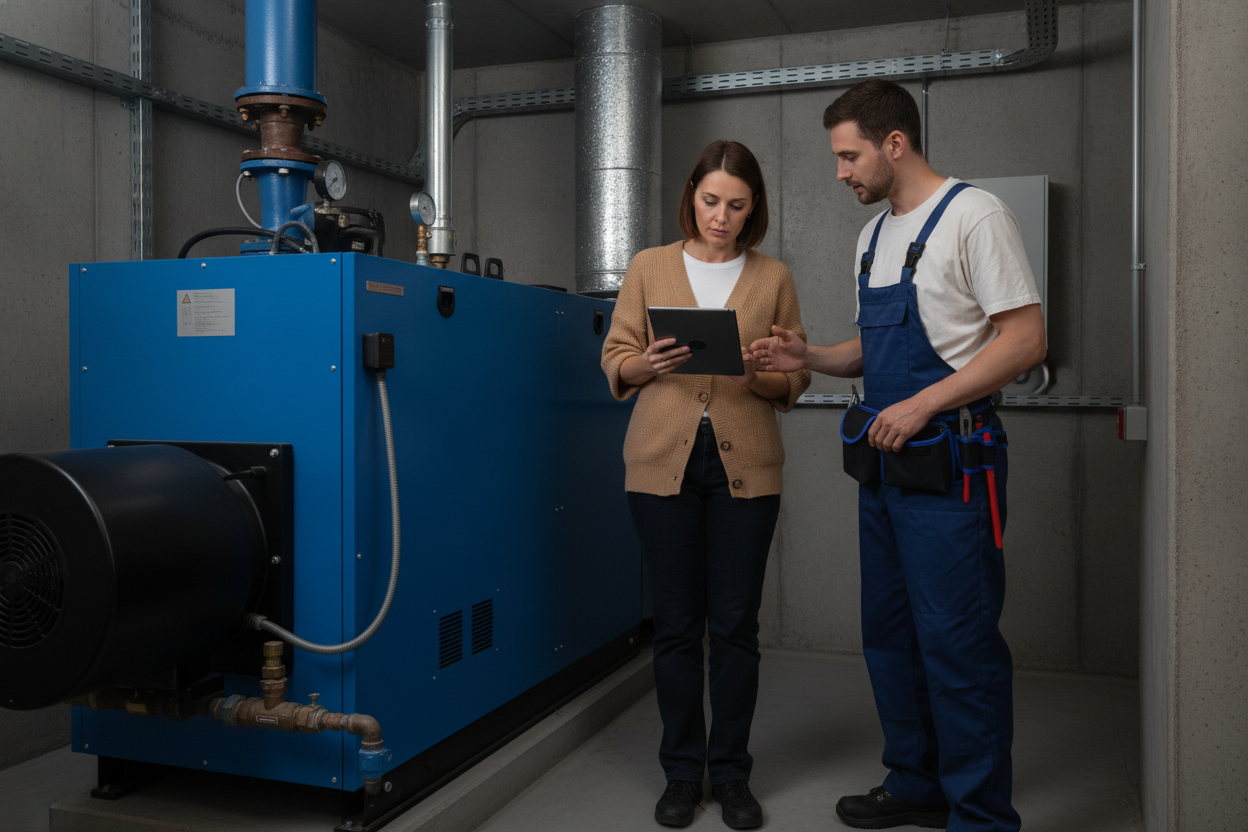
An annual gas safety inspection is the legal minimum for a commercial boiler. It is not a maintenance plan. A working commercial boiler maintenance checklist (much different from a home maintenance checklist) runs on three cycles: quick monthly checks by whoever manages the building, a quarterly look at water quality and controls, and a full annual service by a Gas Safe registered engineer holding the commercial qualifications, not just domestic ones.
And the boiler is one item on a much longer list. Emergency lighting, fire safety equipment, fixed wiring, water systems and backup power all sit on their own schedules. Missing those is what turns a minor fault into a building nobody is allowed to occupy.
The Monthly Checks Anyone Can Do
These take ten minutes and catch most of the problems that turn into weekend callouts. Keep a plant room log and write the readings down, because the pattern matters more than any single number.
- System pressure on each boiler and the pressurisation unit. A slow drop over weeks means a leak somewhere.
- Flow and return temperatures. A widening or shrinking gap points to pump or flow problems.
- Visible leaks, staining, corrosion around joints, and water on the plant room floor.
- Fault codes and lockouts, including ones that cleared themselves. Repeated lockouts are a warning, not a glitch.
- Plant room ventilation grilles clear, and nothing stored against the boilers.
- Carbon monoxide alarms and gas detection tested, plus the emergency control valve accessible and labelled.
Quarterly and Annual Work for the Engineer
Under the Gas Safety (Installation and Use) Regulations 1998, whoever controls the premises has a duty to keep gas appliances and pipework in a safe condition. In practice that means an annual service on every boiler, with the flue, combustion analysis, heat exchanger, burner, seals and safety interlocks all checked and recorded.
Water quality is the item most often skipped and the one that quietly wrecks plant. BS 7593 sets out annual testing of system water, and a laboratory sample will tell you whether inhibitor levels have dropped and whether corrosion or bacterial growth has started. Magnetic and strainer filters should be cleaned quarterly in a busy system.
Other annual points worth having on the schedule: pump and valve operation, expansion vessel charge pressure, pressure relief valves, controls and time clocks matched to how the building is actually used, and insulation on exposed pipework. If you run a steam or high-temperature hot-water plant, that falls under the Pressure Systems Safety Regulations 2000 and requires a written scheme of examination, which is a different exercise altogether.
Heating Is One Part of a Much Bigger Picture
Plenty of Westminster buildings have a well-maintained boiler sitting in a plant room where the emergency lighting has not been tested in three years. Preventative maintenance only works when it covers everything a building needs to stay open and safe.
HVAC and Ventilation
Filters, coils, condensate drains, and belts on air-handling units need attention at set intervals, usually quarterly for filters in central London, where dust loading is high. Air conditioning systems with a certain refrigerant charge require F Gas leak checks within five years of the system installation, and systems with an effective rated output over 12kW need a TM44 inspection at least every five years. Poorly maintained ventilation also makes the heating work harder than it should.
Electrical Infrastructure
Fixed wire testing (an EICR) is typically carried out at intervals of up to five years for commercial premises, with the exact frequency depending on the building type and use. Portable appliance testing, distribution board thermal checks and surge protection sit alongside that. Loose terminations and overloaded circuits are a common cause of both nuisance tripping and fire.
Emergency Lighting and Fire Safety
BS 5266 expects a short monthly functional test of emergency lighting and an annual full-duration test, normally lasting up to three hours. Fire alarms need a weekly call point test and servicing roughly every six months under BS 5839, and extinguishers need an annual basic service. Fire doors, dampers and escape routes should be inspected regularly, and in taller residential blocks the inspection requirements are stricter again.
Water Systems
Legionella control follows a written risk assessment, with monthly temperature checks at sentinel outlets, quarterly cleaning of showerheads and flushing of little-used outlets. Cold water storage tanks need annual inspection. This is a genuine health risk rather than a paperwork exercise, so if you are not confident in your assessment, get a competent water hygiene contractor to review it.
Backup Power
Generators and UPS units fail when they are needed precisely because they are never exercised. A monthly off-load run, an annual load bank test, fuel condition checks and battery testing are the basics. Fuel left sitting for years degrades, and that is a common reason a generator starts and then stops.
For buildings that need a temporary supply during plant replacement or a planned outage, diesel and hybrid generator hire is available via wbpsltd.co.uk on a UK-wide basis, covering events, project work and installations.
Why the Planned Approach Costs Less
Emergency work is expensive because you pay for the callout, the out-of-hours labour, the parts at whatever price is available that day, and the disruption to your tenants or staff. A planned visit costs a fraction of that, and it spots the failing pump seal before it floods the plant room.
There is a second reason to keep good records. From 2031, as per Gov.uk, privately rented non-domestic buildings over 1,000 square metres in England and Wales are set to need an EPC rating of B where cost-effective, following the government’s interim response in June 2026, while smaller buildings stay at the current E minimum. Requirements can change, so it is worth consulting a qualified energy assessor or compliance specialist to confirm what applies to your property. A well-maintained plant with documented service history and sensible controls puts you in a far better position when that assessment happens.
Build the schedule once, assign each item an owner and a frequency, and keep one central log. Most commercial heating failures we see are not mysterious. They are known issues that nobody was watching.